Tuesday, 18 December 2018

Tambdi Surla and Dudh Sagar Trek - by Latha Ramanan

"The earth has music for those who listen."

(Unknown Author)    


Tambdi Surla Trek

We went on train from Bangalore to Kulem, and on road to the camping site. We had lunch at camping site and started towards the trekking trail of 7Km, with the guide. We first visited the Mahadeva Tambdi Surla temple.

On the way to Kulem


Kulem station

Camp site


Mahadeva Temple,Tambdi Surla
From the beginning, it was an invitation to be in nature. Each step was taking us deeper into the forest through narrow walking trails. The guide walked in front and our fitness coaches walked interspersed to motivate the group members to keep moving. We walked almost along the stream, hearing the gushing sounds of water. Even the narrow path we tread on were loose stones and wet soil,indicating that during rains this path also fills up with water. 


Tambdi Surla Waterfalls
Weather being dry we were lucky to be free from leeches, snakes and swimming across streams. Chirping of birds, a warm climate, sun rays filtering through canopies,  up and down terrain created by strong roots of old trees, climbers, thorny shrubs were equally challenging and thrilling. Being in an enthusiastic young group was a positive force that motivated everyone to move towards the Tambdi Surla waterfalls inspite of depleting physical energy. I wasn't prepared to bathe in the waterfalls but seeing majority of the group members straight under the falling waters prompted me to grip the rocks and balance over slippery rocky water bed and bathe parts of my body including head, also drank that pristine sweet medicinal water. I was compensating, absorbing in and imprinting virgin nature's gifts as much as possible. We miss out so much living in polluted concrete jungles, it was a reminder to reconnect every now and then with nature as well as reduce interfering with natural ecosystem as much as possible. One of the precautions I took was to avoid plastics and resist polluting such a beautiful place with my litter.

Day 1 ended with dancing and singing around campfire; afterwards we had dinner. Most of the group members slept in tents; some slept in modest rooms which were used as changing room, within the compound.

Day 2 Dudhsagar Water Falls


We had some fruits, cucumbers, bread with jam and peanut butter as breakfast. Later on we left the camping site for good, with our luggage bags to the main attraction of the trip, Dudh Sagar falls. We went in 4X4s to Dudh Sagar entry counters which had long queues. Bought tickets and rented life jackets; here cameras, video cameras etc. have to be paid for at the gates. Water bottles are marked and have to be shown at the gates while returning or else there's a fine (supposed to be for reducing plastic waste).
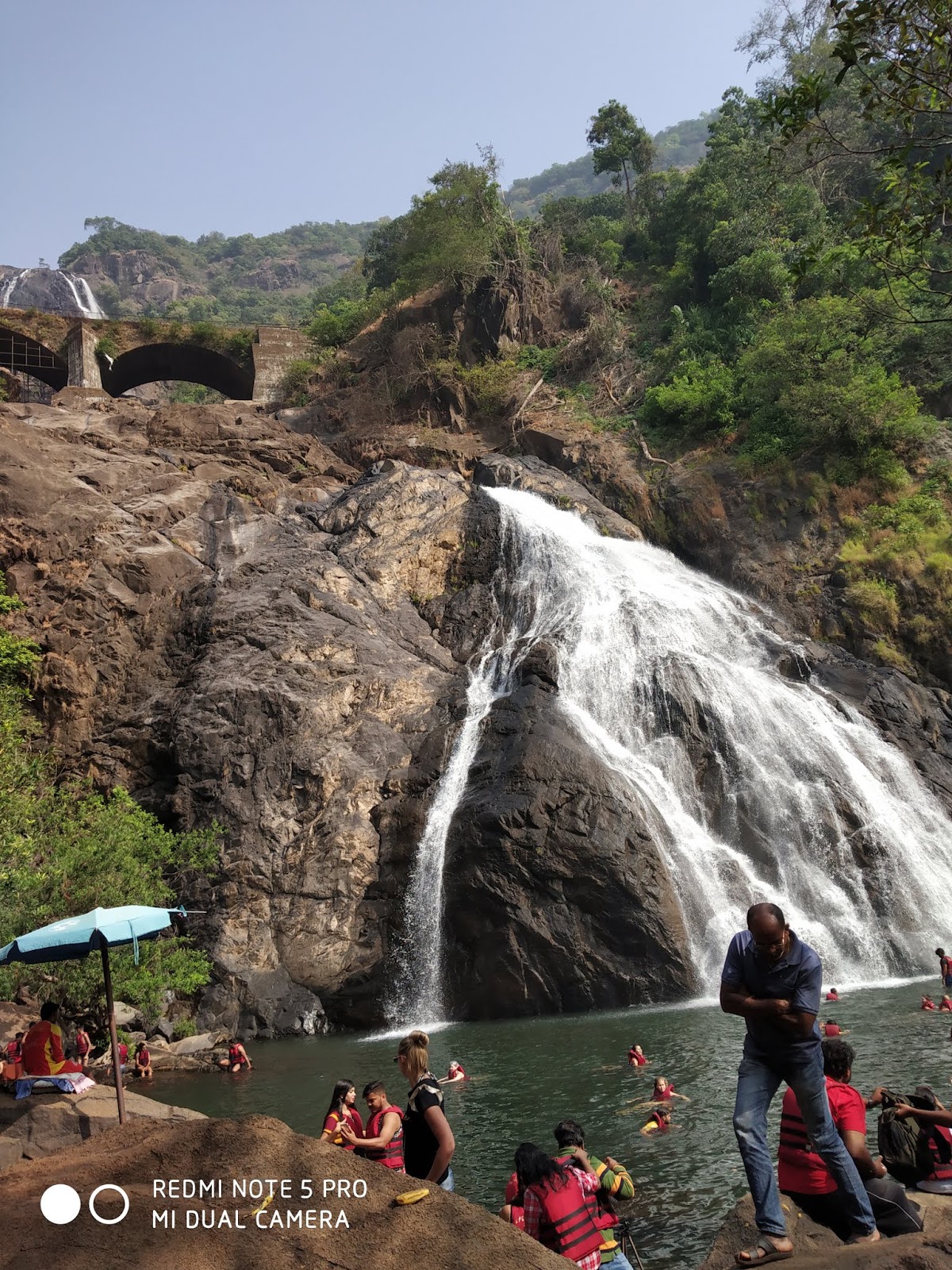
Dudh Sagar Waterfalls


Dudh Sagar Waterfalls


We got onto our assigned vehicles for 9 km travel through a dirt road through forest. Vehicle is slowed down to see the railway track on the hill slopes, seen over the Dudh Sagar falls. This trip across the forest is exciting; we get to cross streams that over flow across low lying bridges. Once we reach a point where the dirt road ends, vehicle journey ends and have to proceed to the water falls on foot. The most challenging and exciting part is the swim wearing life jackets, in the Dudh Sagar falls. Our group members were cooperative to offer hand to swim towards falling milky waters and return to the banks. The waters are deep at some places and at others gigantic roots or rocks offer some place to sit or hold on. Within an hour or so and before the physical body shivers in the cold waters and exhaust out, we have to come out of the waters. Also, there's a time limit of one and a half hours to return to the parking lot. Dudh Sagar became a popular tourist spot after some scenes of the movie 'Chennai Express' was shot over here.  Visiting season is between October and May. Visit is not allowed during the monsoons.
We did some small shopping, had lunch from there and moved on to Kulem for boarding on a connection local train to Londa to catch our main train to Bangalore, a night journey.
On the whole, the energetic and supportive group plus the experience of being in pure air and staying amidst greenery and drinking clean water was a refreshing rejuvenating and healing experience.

Monday, 19 March 2018

Woman Who Inspires Me by Latha Ramanan

(Photo courtesy: Internet)

Woman Who Inspires Me

One of the strong women, apart from my mother - the first role model, I admire and has influenced my career choices and way of living is Medha Patkar. An alumni of TISS (Tata Institute of Social Sciences),  a professional social-worker who left her comforts and scholastic life to the cause of slum dwellers, unorganized labourers, street hawkers, forest dwellers and thousands of villagers who live around river Narmada. She could have lived a carefree  family life with her doctorate in hand, instead she chose to live for and with the villagers, discontinuing her PhD studies. She used her studies to bring social justice to the unorganized masses. Many times when Medha Patkar fought for social and environmental causes she would be seen as an enemy by the government or the people with power and had risked her life to bring about changes in policies to accommodate rights of  the affected communities.  

Whenever I think of higher studies I would remember people like her and that unless it would offer skills to serve society I will not take up any study. Her life has been an inspiration for me to take up social causes and be the agent of social change while being content with a simple living.  When I worked in social projects where I had to reach out to rural communities  by walking miles through unknown places I would remember her months long walks through villages in her social justice campaigns. Somehow a new spirit of joy and motivation fills me up and a courage to engage in selfless work in the role of a social change agent.Over the years, I have mellowed to look within and to work silently as a social change agent, without any titles.  The spark kindled by strong personalities like her and from my own family still lives in me, as strong as ember - an ash covered red-hot charcoal that looks like put-out fire externally yet ready to ignite whenever it is required. A strong warrior fights  relentlessly and courageously for silent masses until justice is done to them!I dedicate this article to the warrior in Medha Patkar who is still  fighting for the rights of rural people for the last 30 years plus.

Ref: https://en.m.wikipedia.org/wiki/Medha_Patkar


(Written for a voluntary agency for Woman's Day, on the same title,"Woman Who Inspires You")

Thursday, 16 November 2017

Surrender to Nature by Latha Ramanan


(Photo Courtesy: alamy.com)

Surrender to Nature 

by Latha Ramanan

Lying on lush green grass, with arms and legs spread out,

I allow the grasshoppers and bugs to run on my body,

Panorama of sky expands my paradigm.

My body sinks deeper on the lap of Mother Earth,

Muddy scent of breeze initiates relaxation in me.

Tiny shimmer of stars in the dusk attracts star particles in me.

Resting in silence I hear the parliament of my thoughts,

Huddled up babblers wearing me out,

Let me surrender the weight of my thoughts to Mother Nature,

There…. I feel light again,

I stay still enjoying darkness and solitude!


Saturday, 7 October 2017

Importance of Yogic Sleep (Yoga Nidra) By Latha Ramanan


Importance of Yoga Nidra (Yogic Sleep) By Latha Ramanan

                                                                     (Photo Courtesy: Carol Trevor)

Yoga Nidra (Yogic sleep) is a way to rejuvenate, repair, heal and balance energy, body and mind. It is sometimes compared to power nap; power nap is short sleep that rests body and mind that leaves the person refreshed afterwards, whereas yogic sleep is a deep state of rest that heals the body and mind.
Yogic sleep can be practised on its own or usually, at the end of a yoga session to gain maximum benefit. It has a meditative quality of rest where the person experiences a stage between awareness and sleep.
Duration of Yoga Nidra can be 5 minutes to as long as one hour depending on the need or choice. For example, during bodily weakness one may not be able to practice physical yoga (hatha yoga) and may have to stick to pranayama and or yoga nidra on the bed. At another instant, a 5 -10 minutes of yogic sleep is sufficient at the end of yoga class, after practising all the yoga asanas (poses).

Benefits of Yoga Nidra         
It improves sleep and other metabolic activities such as digestion, excretion, etc.
It helps in balance of energy through the system
It aids in speedy recovery from illness.         
It creates mental peace and refreshes the body to come out of lethargy.
It boosts immunity.
It removes mental blocks such as fears or traumas that were deep rooted or suppressed.
It relaxes the nervous system.


(Photo Courtesy:Zen Mountain Monastery)


How Yoga Nidra can be practised

Best practice would be to attend a yoga nidra session under a yoga teacher but if that is not possible the method can be studied from books or other audios by experienced yoga instructors. There are many techniques of yoga nidra practice.
Yogic sleep is usually practised by resting in savasana (relaxation by lying on the back) with a relaxed body and closed eyes. In yogic texts it is mentioned that we are made of pancha koshas(5 sheaths/ layers) that is,1. physical layer/annamaya kosha, 2. Pranamaya kosha/energy layer, 3.mental layer/manomaya kosha , 4. Intellectual or wisdom layer/vijnanamaya kosha and 5.divine layer/anandamaya kosha. Yogic sleep guides to rest the physical layer and sink deeper into consciousness of other sheaths, sometimes dip into all sheathes/layers or sometimes one or two of them and return to the awareness of physical body.
Practise starts with moving the awareness from toes to head, relaxing each part of the body, becoming aware of breath and consequently the mind, with an attitude of a witness- not getting involved in any process or judging anything, be it sensation or a thought or an outside sound. There is a possibility of slumping into sleep that is also all right if you have enough time on hand although the purpose of yoga nidra is to be in awareness state between wakefulness and sleep.
A positive affirmation or a sankalpa(a short resolve) can be said  silently in the mind, at the beginning and end of the yogic sleep so that it becomes a sub-conscious guide/ seed to give purpose to life and move towards life goals in an accelerated pace.
Coming out of yoga nidra is done as gently as possible, moving the toes and fingers and deepening breath to come back to body consciousness and if yoga nidra is practised in lying down posture, slowly turning to one side from lying down position to sit up with minimum movements.
Happiness, high energy, balance in energy and peace of mind felt after an effective yoga nidra is beyond words, it has to be experienced!


Saturday, 8 July 2017

TWIN FLAMES By Latha Ramanan


Twin Flames by Latha Ramanan

                                                                                                            (Photo courtesy 123rf)

Ancient souls we are,  lived many births yet we searched for each other,
To merge again into that oneness,  of two bodies with one soul.
We meet again at the end of the cycle of birth and death,
This time a bit wiser, loaded with maturity acquired from past births.

One deep look into the eyes we saw the familiarity of being twin flames,
Leading parallel lives elsewhere,  two bodies with same soul, bound by the divine invisible threads.
One touch of the fingers, brought the images of lives we crossed paths,
One deep breath gave the whiff of known body odour,
We whispered sweet nothings, naturally, in the first meeting itself,
Images of lives together surfaced in the mind,
Some well lived, some thrashed in the waves  of egos and worldly matters,
Forgetful of the source of origin and our soul connection.

Now that we met and found the soul connection,
Shall we live together till we shed the body?
Shall we live apart as before, cherishing the love till the last breath?
Letting go of the urge to build a nest,
Resisting the folly of slipping into vicious cycle in drama of  life?
Shall we break-away from artificial social duties and identities we think we have?
Shall we dig Earth, cut trees, spoil ground water in the name of building our home ?
Shall we produce more offsprings to the already over-populated world ?
Shall we explore each other's body in search of  peripheral  physical love? 

This time let us be wise,  avoiding the mistakes we made in many births?
Shall we, for a change, protect each other from 'falling' in love ?
Let us rise in the love rather than fall,  saving each other from pain and sacrifice of sincere love ?
Let us leave each other to one's  peace and freedom.

All said and done I want to be quite now,
My eyes are foggy, vision is blurred, tears are over-flowing,
They have by now smudge the words I wrote,
Although with heavy heart I let you go,
I am content that I saw myself in you and can wish you well where ever you live,
I have chopped half of me and offered to you as parting gift,
Let me gather myself in silence learning to live with what is left in me,
Ready to breathe my last, having seen my twin flame in the end of this birth cycle.

Saturday, 24 June 2017

THE DESCENT OF LORD by Latha Ramanan

THE DESCENT OF LORD

24 June 2017


THE DESCENT OF LORD By Latha Ramanan

Childhood ensured to live in yearning of my Lord,
Youth reaffirmed that I was born for Him,
Later years showed the path to Him,
Recollecting merging in Him is the soul's sole purpose.

Somewhere along the rugged, unbeaten road of life,
I lost the confidence to ascend towards Him,
When the last hope of meeting Him died,
I cut off my golden wings of flight.

Pain of separation from the Lord exceeded,
The deliberate act of chopping off wings of freedom,
I replaced on the wounds boulders of duty
And sensors to see Him in all.

Blood oozed from the unhealed wounds every now and then,
When my Lord's memory enlivened in the heart,
Blood oozed from wings,  then from the heart and eyes,
Till the dripping blood formed trails wherever I went.

I took an oath not to search for Him anymore,
Each moment has been spent in Him, now it was His turn to find me.
Wingless and blocking my path to Him with rocks of altruism, I remained.
He would have to follow the bloodied imprints I left.

The Lord had to descent, He couldn't resisit the pull,
How could He ignore the austerities of His beloved?
How can he be indifferent to a soul waiting to merge in Him?
How can He turn a blind eye to the river of blood that flowed from the sacrificial life?

Have faith my friend, when you know your soul's purpose,
Each experience in your life leads you to your destination,
Your life is worth living, you have a right to be in your space,
Everything around you are blessings and guidance in disguise.

Sunday, 18 June 2017

EVEN BUDDHA CRIES SOMETIMES

*Even Buddha Cries Sometimes* By Latha Ramanan
Listening to the woes of thousands,
Buddha stood still in the stone statue,
Absorbing and annihilating their sorrows,
Raising the masses to a higher plane each moment.

Amongst the crowd Buddha searched
For a soul that is away from the drama called life,
Not carried away in the world,
Living in the world but not of the world.

Often found a glimpse of such souls
In a desireless little girl who offers a flower
To Him with a smile from the heart,
In a content monkey, cow or dog that visits Him.

He discerned the same light as in Him
In the ever-giving effulgent Sun,
Benevolent full moon, undaunting waves and soothening breeze,
Where is such unruffled beings in human form?

Buddha sometimes loses tranquillity over the drama-driven human lives,
Who are inept to resonate His truthfulness,
fearlessness and compassion,
He cries sometimes perceiving human forms'
Inability to reverberate His universal healing love.

Friday, 2 June 2017

BE LOVE


Be Love by Latha Ramanan
Be Love from the silence of the Heart ,
Never be love of someone alone,
Never rationalise your love or be lovelorn,
Be love from the Heart.

Be the ocean of love, drowning all the passersby,
Sharing your love unconditionally, not knowing why,
Let each cell in you vibrate love,
That resonate in a passing butterfly,  an ant, a dog or a dove.

Let the love in you heal the world,
Give hope to humanity to be bold,
Let all walls and fears be wiped,
Break all the chains that the mind hyped.

Monday, 4 May 2015

                                                           Kids Summer Programme April/May 2015


Amla (Gooseberry) Health Drink


To make Gooseberry Ginger Detox Drink, blend 1 cup of chopped gooseberries, 1 inch piece of ginger, juice from 1 lemon,1/2 teaspoon black salt or regular in a blender with some water. Strain the juice into a glass. Serve with sugar and ice cubes(optionals).
(Recipe courtesy Archanas Kitchen).
(Photo copyright Sivashakti Yoga Bangalore)

Wednesday, 21 August 2013

Angels in Love by Latha Ramanan

Angels in Love  (Photo-art from Desktopnexus)
Angels in Love - By Latha Ramanan


A female angel with white wings fell in love with the dark-winged male angel.  They loved each other long enough till the hues of wings exchanged. Colours on the angels’ bodies emerged as designs on the partner’s body. They forgot their individuality and their hearts became one. They whirled in circles in the sky, moving upwards to the Light as one angel.

Thursday, 7 February 2013


A Tear Drop
(Pic from Fractracer)


A drop of tear is all I have now to offer You,
Rest of what I thought I had is already with You.

Hidden in my heart this tear drop collected stories,
Gaining a rainbow colour with the stories,

Fossilising into a crystal with rainbow glow,
My heart treasured it and could not let it go.

Being aware, I’m offering you the last thing I call mine,
My Heart is empty and light, nothing to hold as mine.

No more stories, no more others; I remain,
All colours and stories disappeared, the being remains.

Tuesday, 1 January 2013

Happy New Year 
        Happy New Year ! 
Lets spread the message of peace this new year with our presence! 
Om Shanti! 
(Photo from fanpop website)

Friday, 31 August 2012

Rawa Laddu/ Semolina balls(Sweet) Recipe

Rawa Laddu/ Semolina balls(Sweet) 
Rawa Laddu/ Semolina balls(Sweet) Recipe

Ingredients
1.Roasted Rawa(Semolina) - 200 gms
2.Sugar(reduce the quantity if you are not sugar toothed) - 200 gms 
3.Raisins -  30 gms
4.Chopped Cashewnuts - 30 gms
5.Ghee/Oil- 2 table spoons
6.Milk/Milk substitute - 2 table spoons
7.Cardamom - 10 nos.


Method:- 
Step 1.Make a fine powder of cardamom and sugar in a mixie, then add roasted rawa(semolina) to that mixture and coarse grind it.


Step 2. In a frying pan heat ghee/oil, fry the cashewnuts to golden colour;add and fry raisins until they are plump. Keep them aside.


 Step 3. In the same pan add the ground cardamom,sugar and rawa(semolina) mixture and milk/milk substitute to the leftover ghee/oil, keep stirring. Keep it on low flame till the mixture has blended well and is dry. Add the roasted cashewnuts and raisins to this mixture.


Step 4. Make the mixture into small balls when it is warm. (*Dip your hands into cool milk before rolling the mixture into balls to avoid burning of palm or fingers.)


Rawa Laddu/Semolina balls are ready to serve! It has less shelf value as it contains milk so finish them quickly or make only a small quantity as mentioned above.


Sunday, 29 July 2012

Raja Yoga


Om
Review of Chapter II, Sadhana Pada,
“Yoga Sutras of Patanjali”,
Commentary by Sri Swami Satchidananda


Introduction
Yoga practice, to a layman, is the hatha yoga and pranayama for keeping the people healthy and stress-free. The real study of yoga is for the mastery of mind. It consists of mainly 4 branches- Karma Yoga, Bhakti Yoga, Jnana Yoga and Raja Yoga.

Here for the review I have chosen Raja Yoga as in Yoga Sutras of Patanjali, Chapter II. As the name suggests Raja Yoga is the king over all other branches of Yoga encompassing other branches as well in its practice. The hatha yoga and pranayama which are the most common things practiced in yoga classes are also part of Raja Yoga.  It employs practical methods to bring mastery over the mind and one day reach the highest Samadhi. I have chosen only the Chapter II for book review as I am more interested in the practice of Raja Yoga. The other chapters can be read for knowledge sake, in my opinion. Any student inclined in Raja Yoga path may do the same.

The primary text of Raja Yoga is called the Yoga Sutras of Patanjali (sometimes also called Patanjali Yoga Sutra or Yoga darsanam). Sutra literally means “thread,” each Sutra being the barest thread of meaning upon which a teacher might expand by adding his or her own “beads” of experience or example, etc for the sake of the students.

There are almost 200 Sutras, traditionally divided into 4 sections. The first is the “Portion of Contemplation,” (Samadhi Pada with 51 sutras). It gives the theory of Yoga and a description of the most advanced stages of the practice of Samadhi or contemplation. The second sutras in this chapter, Yogascitta vritti nirodhah – the restrain of the mental modification is yoga , summarises what Yoga’s goal is. Rest of the sutras are the extensions of this key sutra. The second is the “Portion on Practice,” (Sadhana Pada with 55 sutras). There is philosophy is this section also, but of a more practical nature. And the first five basic steps out of the traditional eight limbs of Raja Yoga are expounded, along with their benefits, obstacles to their accomplishments and ways to overcome the obstacles. The third section is called the “Portion on Vibhuthi Pada”, (on Accomplishments with 56 sutras) and discusses the final inner steps of Raja Yoga plus all the powers and accomplishments which could come to the faithful practitioner. The final section is called the “Portion on Absoluteness,” (Kaivalya Pada with 34 sutras) and discusses yoga from a more cosmic, philosophic point.

It is not known exactly when Sri Patanjali lived, or even if he was a single person rather than several people using the same title. Estimates of the date of sutras range from 500 B.C. to 300 A.D. In any case he did not in any sense ‘invent’ Raja Yoga, but rather systematized it and compiled the already existing ideas and practices. Since that time he has been considered the “Father of Yoga” and his Sutras are the basis for all of the various types of meditation and Yoga which nourish today in their myriad forms.

The Yoga Sutras of Patanjali with Sri Swami Satchidananda’s commentary is a simple and easily understandable explanation of the Sutras. Sri Swami Satchidananda, the founder of Integral Yoga and disciple of Swami Sivananda, has been a beautiful instrument to guide us in the study of Raja Yoga. This book is unique commentary on the Yoga Sutras in that it is based on Swamiji’s informal exposition of the Sutras at lectures and yoga retreats. It was not written for any scholarly or intellectual purpose, but it is the recorded conversation of a yoga Master to his students in true Sutra exposition tradition.

The “I” perspective – How am I affected by the Raja Yoga Sutras?
Few years ago I had read and perused Yoga Sutras, out of personal enthusiasm. The experience was life- changing. I felt like I was not reading the Sutras, it became my sadhana (personal practice).  Each sutra absorbed into my body and mind and turned me inside out. It was a deja-vu feeling. It dawned upon me that the knowledge in the Sutras resonates with my true self or that I must have read them in my past lives. It has been taking me closer to the Truth. Then onwards there is space between the thoughts to realize if a thought is from the present, past or future. Each time I refer some Sutras again, they gave a different meaning, plus an insight into my true self. Hence the review of this chapter is a re-visit to find a little deeper meaning of the Sutras and to keep my mind’s attention inward so that this book review also becomes my sadhana to establish myself in the Truth, rather than an intellectual exercise.

Yoga practice as mentioned in the 2nd sutra of chapter I, is intended to restrain the mental modifications of the mind. I felt that by studying Raja Yoga or the Ashta-anga Yoga (8 limbed yoga), I am practicing control over the body, mind and senses. It is allowing me to control the gross substances such as the body or the breath to control the subtler levels of being such as my mind and the senses. I felt as mentioned by Patanjali in the 2nd Chapter the 8 limbs represent 8 stages; by practicing the yogic values, Yama and Niyama, then moving on to the asana (controlling and making the body supple to be sit comfortably in one posture) and thereafter learning pranayama (practicing retention of breath in the prescribed ratio both naturally and as an exercise), helps to sit in meditation in a posture for prolonged period (2 ½ - 3 hours). This meditation would automatically lead to Samadhi. Therefore as Swami Satchidananda says self-realization is our birth right and everyone has the potential to realize in this birth itself if we can practice Raja Yoga.

The key learning about asana and pranayama for me, using RajaYoga sutras is that- cultivating the habit of being comfortable in one of the meditative asanas such as padmasana , sidhhasana, swastikasana,etc is enough to reach the meditative state and later on Samadhi through dharana and dhyana. Nothing more is required for an advanced yoga practitioner, is a consolation and an amazing learning curve for my mind. My mind has the tendency to desire to study more asanas and different styles, then the way I comfort my mind is to remember this key learning point from the Raja Yoga sutras. Patanjali has not mentioned any other asanas in the whole of Yoga Sutras.

Choosing one yama and Niyama (yogic values) is a beginning step to practice the theory of Yamas and Niyamas in our daily life. Swami Satchidananda in his commentary explains how even sticking even to one yogic value can make us a saint with the example of one of the saints, of 63 Saivite saints or the Nayanars. The fear of death could not deter them from their chosen value hence they all realized before leaving the body. I deeply enjoy this inward journey possible by this review. The meanings I perceived in my initial study of these sutras have shed off. Now there is a realization in me that some of the sutras are not for the mind, they come from a higher consciousness and it is above the understanding of the lower minds.

Summary
In the first sutra of the Chapter II itself Patanjali emphasizes practice of Yoga is nothing but austerity, self-study and surrender to God. This will lead you to self –realization. But there are 5 obstacles namely ignorance, egoism, attachment, aversion and fear of leaving the body, in the order of this sequence. These obstacles prevent us from knowing our real –self. In the Yoga Psychology class too we learnt that it is when there is modification of the mental state that we face these obstacles and they veil our knowledge of the real self(Purusha). In the twelfth sutra, there is a beautiful representation of the forms of obstacles – the future Karma, present Karma and the past Karma. The sutra goes on to say our present and the future Karmas are controllable, whereas the past karmas cannot be controlled easily. Here Swamiji Satchidananda’s explanation with the analogy of 3 types of arrows in the archer’s quiver is also interesting; one arrow has already left the bow (past Karma), another is in the bow (present) and the other is still in the quiver (future). We, as archers can controlled the last 2 types of arrows but the one that has already left the bow (past actions) cannot be controlled.

In the Sutra 14, it is clearly mentioned that happiness or unhappiness in this life time is due to our own Karmas, so if we remember that we will not blame anybody else for the difficulties in our life.
Another important lesson for a spiritual seeker is that pain and pleasure are unreal so a yogi uses his spiritual discrimination for detaching oneself from all worldly pleasures, then only the ultimate bliss can be experienced.

In sutras 17 to 23, it is stated how we can mis-identify Prakriti as Purusha, then a clarification is given that Prakriti is not an enemy; it is there to give us experience and ultimately liberates us from its bondage. As in Jnana Yoga, using viveka and vairagya, we can be a liberated person then the prakriti (nature) is destroyed, and such enlightened ones can serve the world but be unattached to it. In Sutra 24, Patanjali says after Prakriti unites with the Purusha, that individual would laugh at his own ignorance of how I have forgotten myself?

The Sutra 25 and 26 are similar to that of self- enquiry in Jnana Yog. Once the individual asks questions such as who I am and who is happy etc, the junction created by the ignorance is removed, and then the Seer (Purusha) rests in his own nature. “Aham Sakshini” – I am the eternal witness is realized.
The Sutra 27 is a gauge to see where we stand in the spiritual path. It explains Purusha’s different stages of attainment as he gradually goes upwards to rest in his own nature. Referring to the Saptada buddhi (7 wisdoms) mentioned here we can ask ourselves where we are: have we lost the desire to know more, the desire to do anything, etc.

The same ideas given in above Sutras are structured by Patanjali in Sutras 29 to 55. These sutras systematize the method to develop discriminative discernment, thereby leading to self-realization. He has summarized them as Ashtanga Yoga or 8-limbed Yoga. The 8 parts or the steps are namely, yama, niyama, asana, pranayama, pratyahara, dharana, dhyana and Samadhi. In the chapter II only the first 5 limbs are covered, because they are the external or the bahiranga yoga. When we practice these limbs sincerely, the last 3 steps (dharana, dhyana and samadhi) happen on their own.

Summing up, I believe, Raja Yoga principles if followed systematically, as mentioned by Patanjali is applicable even now to realize our true self. Once again, as mentioned by Swami Satchidananda in the commentary, self-realization is our birth right. Once we practice this highest type of Yoga, we all can reach the highest Samadhi in this life time itself.

I dedicate this work to all my teachers and God, who gave me this opportunity to analyze these Sutras and there by analyze myself through this book review.

May all beings realize in this life time!

Hari Om!

Monday, 2 July 2012

Less is More- Key to a Steady Yoga Practice

                                                   Sukhasana (easy pose) :Photo by Sivashakti Yoga,Bangalore
Yoga practice is many times, seen as a sequence of hard poses (asanas) with sweating and generating heat in the body. This practice becomes just another way of punishing your body and mind, creating stress and worries which in turn disturbs the biological rhythm and the human systems. The practice that is meant to provide health and peace of mind changes into a contraindication.
Yoga practice has to be fun, allowing you to feel the connection of the body, mind and soul; on the peripheral level giving you a toned and healthy feeling. Yoga gives more benefits when practised with an open mind rather than for a narrow goal of, say, losing weight. When there is less expectation from the practice the outcome is fulfilling.
If you want to build a regular home practice the key is to split-up your yoga practice into short sessions of 15-20 minutes yoga routines. So in the morning, on en empty stomach you could do a few rounds of sun salutation (soorya namaskar) or few poses and pranayama (breathing exercise).    VoilĂ  – you are energetic enough to rush off and start your daily chores. You could practice meditation and a deep relaxation in the evening, after work or just before sleep, as long as you are not full-stomached. A peaceful sleep is sure to follow. The traditional practitioners insist on following the same sequence mentioned in their particular style of Yoga, but for a layman that would be a wishful thinking. You can practically spare only very little time for your yoga home-practice, while thoughts are scattered in numerous struggles of life. Balancing practice with other commitments in life is a conscientious effort for many yoga students; if not successful the practice slumbers away.
If you look into the classical yoga texts, there is no mention of the need to master hundreds of yoga poses. The emphasis is on focussing on the breath, holding the pose longer, observing the subtle changes in your body and mind etc., as you are in one pose. Infact, practising just one pose into perfection will lead you to the ultimate goal of Yoga, that is, the realisation of your inner self. You can experience that a seemingly difficult pose becomes easier with practise and your mind becomes peaceful. You learn the yogic values also such as truthfulness, non-violence, self-control, withdrawal of senses etc while holding a pose. Less is more. Be at ease with your short practise sessions and gain great results for yourself!  

Monday, 25 June 2012

Sivashakti


Art work by Geoglyphicks

Siva-Shakti

I felt within me the rising of the divine Ma
To meet with her lover, Sivaaya.
I called upon Siva to remove the Maya(illusions)
To root me in truth with his Daya(mercy).
Talked to Him how my japa(mantra chanting) and tapah(austerities)
Seemed so inferior in the presence of the unreal lokah(world).

I called upon Shakti Devi to cool the heat of Rudra(Siva)
Whose energy fountains out through my sahasrara chakra(head chakra).
The Devi who calms the Lord in angry form
Rise up to balance His energy for me to transform.


I am both Siva & Shakti
The union of both that gives mukthi(liberation).
In me dwells both Siva & Sivaai(Shakti)
As reality dwells within the Heart of the I.
A great bow to the universal light, which is also within
that guided me to Shiva-Shakti- the sacred home within.